Best Time to Post Instagram Reels: A Data-Informed Guide
Help creators choose posting windows and use audience data to refine timing decisions.
A data-informed workflow for choosing and testing Instagram Reels posting windows.
By ViralSnap Team•11 min read•Updated Aug 2026
There is no universal magic hour that guarantees an Instagram Reel will perform well. The best time to post Instagram Reels is the time when your audience is most likely to be available—and when your own account has enough evidence to support that decision. Start by reviewing your account's posting windows before choosing a test. General timing studies can give you a starting hypothesis, but your audience, location, format, and publishing history should decide what you keep.
This guide turns posting time into a repeatable experiment. You will use Instagram Insights, compare a small number of publishing windows, keep the most important creative variables stable, and record what you learn. The goal is not to predict the algorithm. It is to make a better next publishing decision.
Posting time matters because a Reel needs an initial audience context. People may be more likely to notice and interact with content when they are already checking Instagram. But early activity is only one part of distribution. A strong hook, clear topic, useful pacing, and relevance to the audience still matter after the Reel is published.
Treat a suggested time as a hypothesis rather than a rule. “Post on Tuesday at 7 p.m.” may be a useful first test, but it is not a promise for every creator. A local business, a student creator, and a global personal brand can have different audience patterns. Even two accounts in the same category can see different results because their followers are in different places and have different habits.
The practical question is therefore: which two or three windows should this account test next, and what evidence will determine whether one deserves another test?
How to Use Instagram Insights to Find Your Best Posting Window
Start with the account’s own evidence. Open the professional dashboard or Insights area available to your account and look for audience activity, follower information, and the performance history of recent Reels. The exact labels and available views can change by account type and product version, so record what the platform currently shows rather than assuming every account has the same report.
1. Identify when the audience is available
Write down the days and time ranges where your audience appears most active. Use a time zone that is meaningful for the audience you want to reach. If your audience is distributed across regions, avoid treating one local time as a complete answer. Choose a primary audience segment first, then use a second window for another segment if that distinction matters to the business.
2. Compare more than one performance signal
Review recent Reels and record reach, views, watch time or retention information when available, interactions, and the publishing time. Do not collapse these into one score. A Reel can receive an initial burst of reach but lose viewers quickly. Another can start slowly and continue to attract useful engagement later. The purpose of the log is to see patterns, not to prove that the clock caused the outcome.
3. Build a simple observation log
Use a table like this for the last eight to twelve comparable Reels:
Reel
Published window
Topic/format
Early signal
Longer signal
Observation
A
Tue 6–7 p.m.
tutorial
reach
watch time
strong first-hour activity
B
Thu 12–1 p.m.
checklist
reach
saves/comments
slower start, useful saves
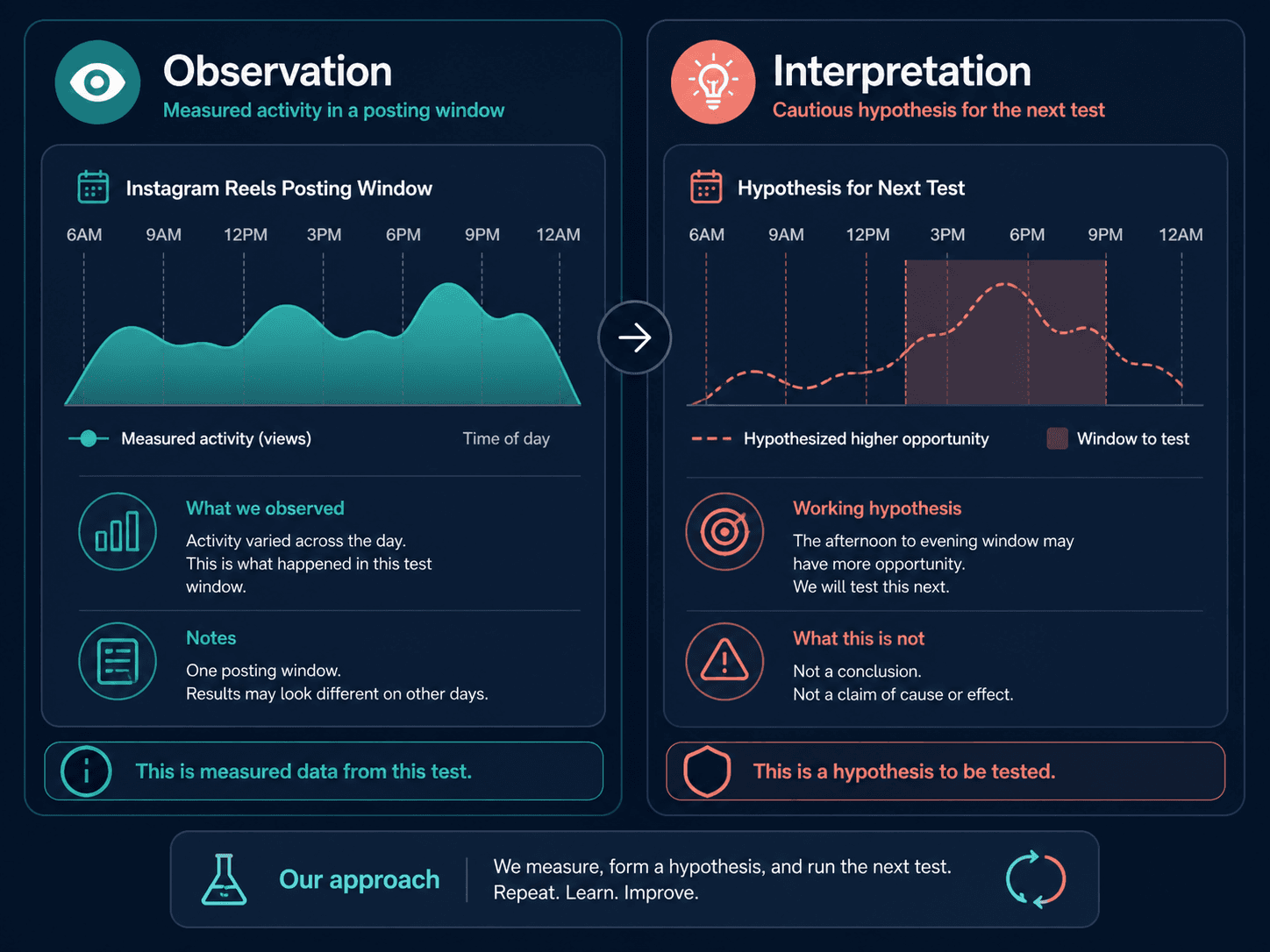
The “observation” column should describe what happened, not explain why it happened. “More views in the first hour” is an observation. “The algorithm prefers Tuesday” is an interpretation that requires more evidence.
How to Test Different Posting Times
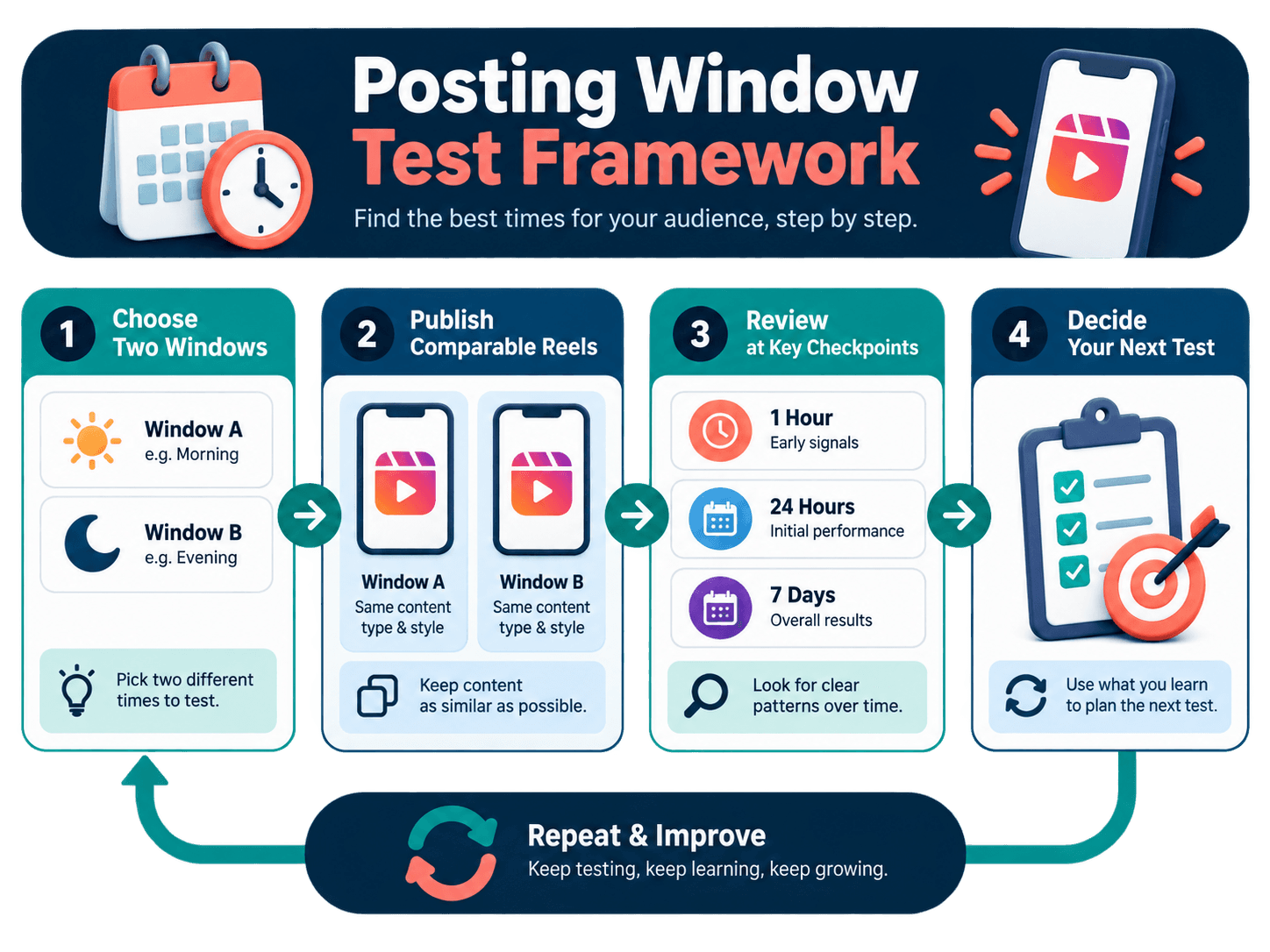
The most useful timing test changes one major decision at a time. Choose two comparable windows, such as weekday evening and weekend morning, then publish similar types of content across both. The content does not need to be identical, and repeating the same video may not be appropriate; the goal is to reduce avoidable differences in topic, audience relevance, length, and production quality.
Posting Window Test Framework
Choose two or three windows from your Insights and publishing history.
Define the audience segment and time zone for the test.
Prepare comparable Reels with a similar content role and production standard.
Publish across multiple repetitions instead of deciding from one post.
Record early and later signals at the same review intervals.
Write one conclusion and one follow-up test; do not change the entire strategy at once.
For example, a creator may compare Wednesday from 6–7 p.m. with Saturday from 10–11 a.m. The creator publishes three educational Reels in each window, keeps the topics within the same audience problem, and records the results after one hour, twenty-four hours, and seven days. If the evening window shows stronger early reach but the morning window produces more saves, the correct conclusion is not automatically “evening wins.” The next decision depends on the creator’s goal.
Define the success signal before publishing
Decide what the Reel is meant to do. Awareness content may use reach and qualified views as useful signals. Educational content may care more about watch time, saves, or profile visits. A product-related Reel may need a downstream action that is not visible in the first hour. If you select the metric after seeing the result, it becomes easy to tell a convenient story.
What to Consider Beyond the Posting Time
Timing cannot rescue a Reel that does not communicate its value quickly. Before changing the publishing window, check the first seconds, the topic, the visual clarity, the pacing, captions, and the next action. A timing experiment should not become a reason to ignore the creative itself.
Hook and early retention
If people leave immediately, examine whether the opening makes the topic clear and relevant. A stronger first line or more direct visual can change early retention more than moving a post by one hour. Treat this as a separate hypothesis so that the timing test remains interpretable.
Audience relevance
The same posting window can produce different outcomes for different topics. A timely question, a recurring audience pain, and a broad entertainment idea may attract different groups. Record the topic and content role beside the publishing time.
Consistency and format
Format, length, caption clarity, visual quality, and consistency can all affect how a Reel is received. Hold as many of these variables steady as practical, and write down the variables you could not hold steady. Honest uncertainty is more useful than a precise but unsupported conclusion.
A Worked Example: Comparing Two Posting Windows
Imagine a creator who publishes short educational Reels for independent designers. Insights shows that followers are active on weekday evenings, but the creator has mostly published on weekend mornings. Instead of immediately declaring weekday evening the answer, the creator defines a six-post test.
The first three Reels use the weekday evening window and cover three related questions about pricing. The next three use the weekend morning window and cover questions of similar difficulty. The creator keeps the opening format, approximate length, caption structure, and CTA consistent. The topics are not copied; they are chosen from the same content pillar so the comparison is useful without pretending the posts are identical.
Before the test, the creator chooses three review points: one hour for early distribution, twenty-four hours for the first complete day, and seven days for the longer tail. The log includes the publishing time, reach, views, average watch time when available, saves, comments, profile activity, and a note about any unusual event. A post that is shared by a larger account is marked as an exception rather than silently treated as normal evidence.
Suppose the evening group has a higher median first-hour reach, while the morning group produces more saves per reach. The next choice depends on the content goal. If the goal is broad awareness, the evening window may deserve another test. If the goal is helping people save a tutorial for later, the morning window may be more promising. Neither conclusion proves that time caused the difference. It only identifies the next question to investigate.
The creator then changes one variable in the next cycle. For example, the next test may compare the same two windows with a stronger first-line explanation while keeping the topic range similar. If both windows improve, the hook may have mattered more than timing. If only one improves, the creator has a more specific observation to examine. This is why a timing log should preserve both the numbers and the creative context.
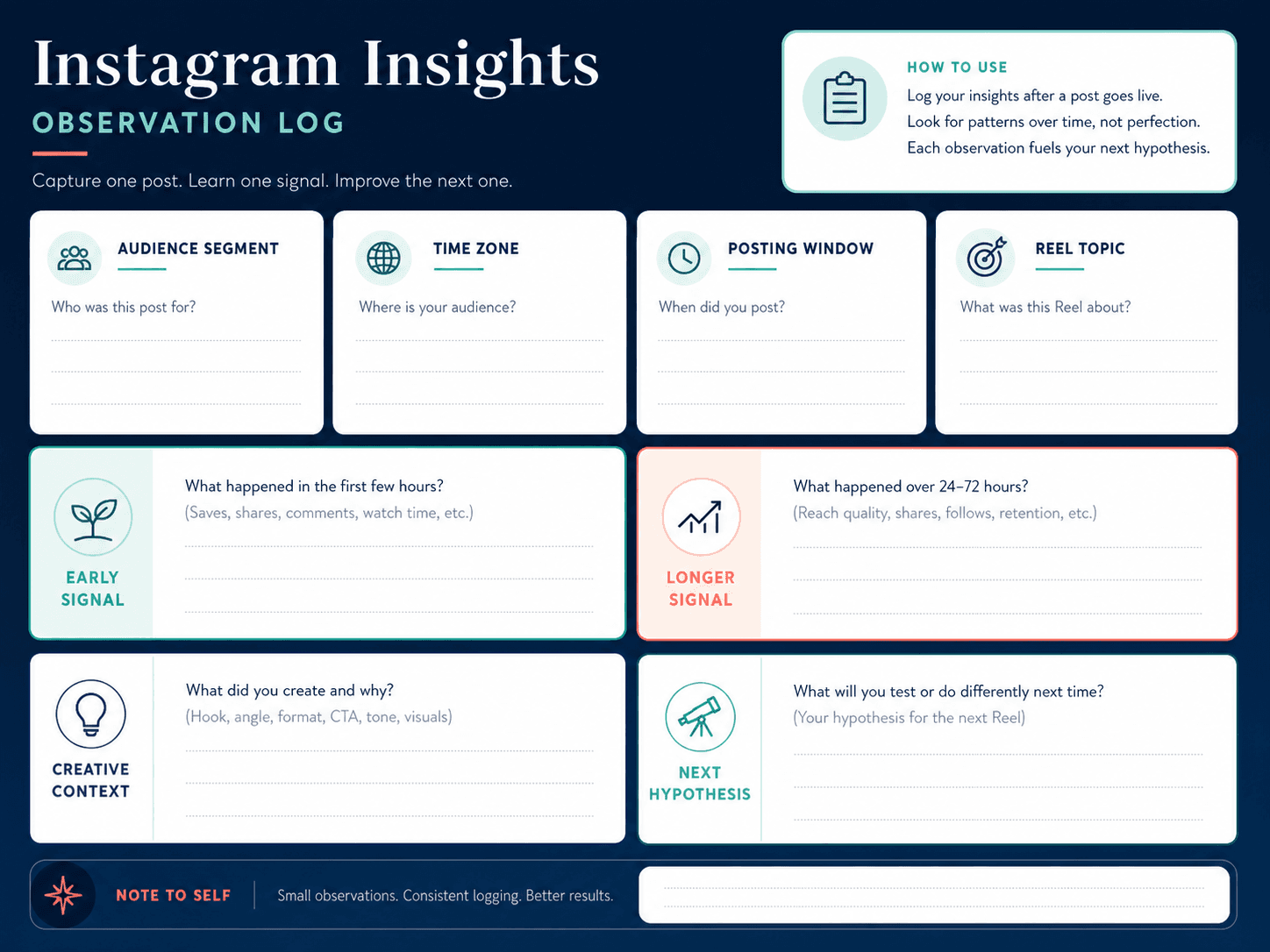
The Instagram Insights Observation Log
At the end of each week, add five short notes:
Audience context: who the test was intended to reach and which time zone was used.
Window tested: the exact local time range, not just “evening” or “morning.”
Creative context: topic, format, length, hook type, and CTA.
Observed signals: the measurements and review intervals used.
Next decision: repeat, change, or retire the hypothesis, with one reason.
This log makes the decision reviewable. It also prevents memory from selecting only the best-looking result. If a creator later changes audience, region, or content format, the old records remain useful as historical context rather than being treated as a permanent rule.
What the test should not claim
Do not write “this time caused the Reel to go viral” from a small comparison. A responsible note names the sample, the time windows, the signals, and the uncertainty. For example: “Across three comparable posts, the evening window showed higher median early reach; we will repeat the test with the same audience segment before changing the publishing schedule.” That sentence is useful because another person can understand what was measured and what remains unknown.
This discipline keeps the publishing decision useful even when the result is inconclusive. That is the point.
A Practical Instagram Reels Posting-Time Workflow
Use this weekly loop:
Action steps
Collect: export or record recent Reel performance and the original publishing windows.
Observe: mark audience activity and notable performance signals without explaining them yet.
Compare: group posts by comparable topic, format, and window.
Hypothesize: choose one posting-time question for the next cycle.
Test: publish a small set of comparable Reels across the selected windows.
Review: compare the predefined signals at consistent intervals.
Update: keep, revise, or retire the timing hypothesis and choose the next test.
The workflow creates a record that can be reused. It also prevents a common mistake: changing time, hook, topic, format, caption, and CTA all at once and then attributing the result to timing.
FAQs About the Best Time to Post Instagram Reels
Is there one best time for every account?
No. General studies can provide starting points, but account-level audience activity and publishing history are more relevant to the next decision.
Should I post on weekdays or weekends?
Test the days that match your audience activity and content purpose. Compare comparable Reels rather than assuming a weekday or weekend is universally better.
How many posts do I need before deciding?
There is no single reliable number for every account. Use enough comparable posts to avoid making a decision from one unusual result, and repeat a window when the decision matters.
How often should I revisit posting time?
Revisit it when your audience, geography, content mix, or publishing cadence changes, and periodically review whether old patterns still describe current behavior.
Final Takeaway
The best time to post Instagram Reels is not a permanent number copied from a generic chart. It is a working hypothesis grounded in your audience activity, your content history, and a test you can repeat. Start with Insights, define the signal before publishing, compare a small number of windows, and keep timing separate from the other creative variables you are learning about.
If you organize the observations and turn each result into a clear next experiment, posting time becomes part of a learning system rather than a superstition. The goal is not certainty after one Reel. The goal is a better decision after every review cycle.
Reader takeaway checklist
I can name the audience segment and time zone for my next test.
I can compare at least two posting windows using the same review intervals.
I can separate an observed signal from an explanation about why it happened.
I can choose one next experiment instead of changing every creative variable at once.