
Creator Workflow
UGC Scripts: Examples, Templates, and How to Write Your Own
Learn how to write UGC scripts with 8 complete examples, 6 reusable templates, script anatomy, and a practical hook-to-CTA workflow.
Sep 9, 2026
 ViralSnap AI
Learn how to analyze spoken hooks, on-screen text, first frames, and transitions—then adapt observations into original Reels experiments.

Keep exploring
Creator Workflow
Learn how to write UGC scripts with 8 complete examples, 6 reusable templates, script anatomy, and a practical hook-to-CTA workflow.
Sep 9, 2026
Video Analysis
Learn a repeatable workflow for observing reference videos, extracting structures, and turning those observations into original content experiments.
Aug 17, 2026
Start Free
If you are researching hooks for Instagram Reels, another giant swipe file is rarely the best next step. A more useful question is: what can you actually observe in a Reel's opening, and how can you adapt that structure without copying the creator or assuming it will produce the same result for you?
A Reel hook is a coordinated opening window, not just a sentence. Spoken words, on-screen text, the first frame, and the opening transition can work together to establish a problem, question, tension, or promise. This guide shows you how to analyze those channels, compare them carefully, and turn a useful observation into an original experiment for your own audience.
The working loop is Observe → Compare → Interpret cautiously → Adapt → Test. It is a learning workflow, not a formula for predicting what a Reel will do.
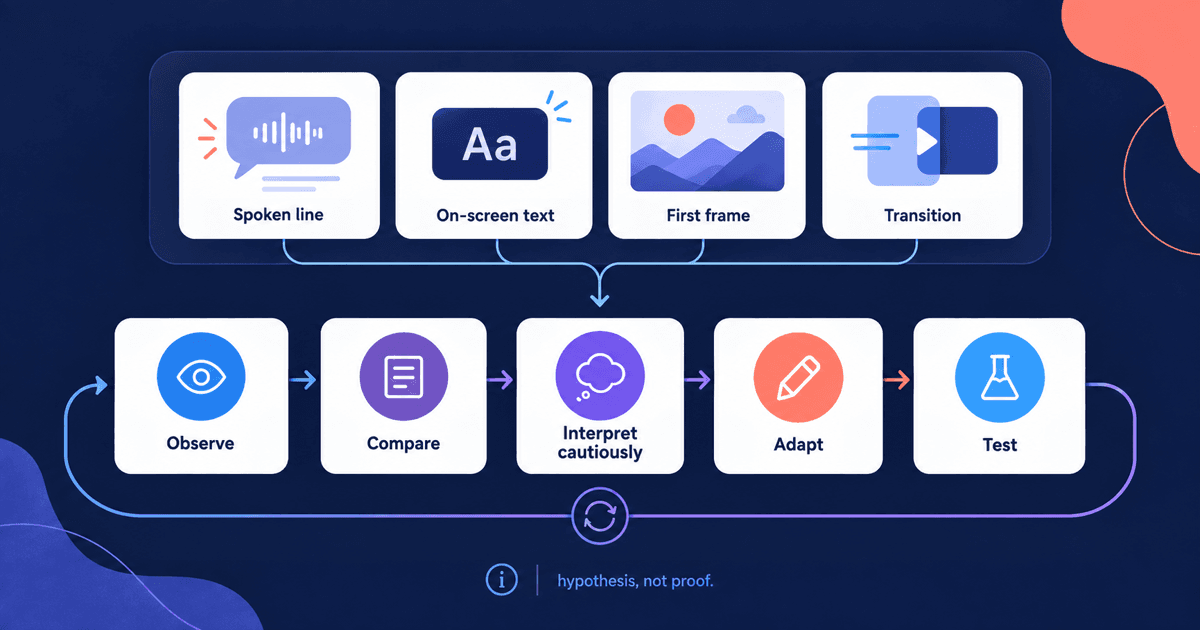
Treat the hook as the opening information window rather than a single line of dialogue. Your inspection window should be consistent across the videos you compare, but it should remain a working choice—not a universal first-three-seconds or three-to-five-second Instagram rule.
Record four channels:
These channels do not have to appear in the same order. A Reel might begin with an action, add a clarifying overlay, and then explain the question verbally. The useful observation is the sequence and the information each channel contributes—not a ranking of hook categories.
Meta's Reels creative guidance discusses vertical creative, audio, safe-zone placement, and testing creative variants. That is relevant production and testing context, but it is ad guidance and bundled creative evidence, not proof that one organic opening variable causes a particular outcome. Buffer's hook guide is practitioner guidance that can help you name patterns such as specificity, curiosity, contradiction, and mid-action entry. Use it as a source of prompts, not as controlled Instagram evidence.
Start each analysis with a small record: reference ID, question, inspection window, spoken line, overlay timing, first-frame description, transition event, and what remains unknown. The record should let another person verify what happened before reading your interpretation.
First, transcribe the first meaningful spoken line and note when it enters. Then label its function descriptively: does it name a specific problem, ask a question, narrow the audience, state a promise, introduce a contradiction, or create tension?
These labels are not performance categories. They make comparison easier. A line such as “Here is the mistake that keeps making this recipe watery” can be recorded as a specific problem plus a promised explanation. The next check is whether the Reel actually fulfills that promise. Compare the opening with the later explanation; do not turn that match into a claim that the line caused retention, reach, or engagement.
The academic source in this package, the Douyin/ICH short-video study, separates text and transcribed speech from visual, musical, editing, and opening-scene features. Its sample is not Instagram Reels. It is useful here for measurement framing and for showing why text-only analysis is incomplete—not as Reels performance evidence.
Use a spoken-hook note with five fields: exact line, entry point, function label, promise, and payoff. Add a final field called “not established.” For example, “the creator names one recurring learner mistake” is observable. “The line makes viewers stay” is an interpretation that needs separate evidence. A safer next question is whether a similar problem statement is worth testing with your own audience and original wording.
For overlay text, record the exact words, when they appear, where they sit, how readable they are on a phone, and whether they repeat, clarify, or extend the spoken hook. For the first frame, record the subject, action, framing, background, and context before explaining why any of those choices might matter.
The safe-zone check is production hygiene. Meta's Reels materials describe keeping key creative elements in the safe zone. You can therefore check whether text is likely to be obscured by interface elements and whether the first frame communicates its subject on a small screen. You cannot turn safe-zone compliance into a performance promise.
Audio needs the same discipline. Instagram's music-library guidance distinguishes licensed music access from commercial-use options such as Sound Collection, with account and regional constraints. Record the source and usage condition. Do not present a sound choice as a guaranteed discovery or reach lever.
A practical first-frame log asks four questions: What is visible? What is moving? What context is already available? Does the text repeat or complement the image? Add “What cannot be known from this frame?” That last question keeps a clear line between visual inspection and an explanation of audience response.
Describe the transition before interpreting it. Use neutral terms such as cut, reveal, movement, zoom, or entry during action. Note the order and the information change: does the transition introduce the subject, show a result before the process, create contrast, or change the context of the spoken line?
Imagine a ceramic maker beginning while removing a piece from a kiln, then stating the question the Reel will answer. The observation is “the action appears before the explanation, followed by a result reveal.” The experiment prompt might be “could my own audience understand the topic more quickly if I begin with an original action?” The observation is not “motion caused attention.”
Hootsuite's Reels examples can help generate questions about getting to the subject quickly, but its examples are practitioner guidance and anecdotal cases. Do not generalize a timing recommendation or attribute an outcome to a transition. A transition is a visible production choice that can become a bounded prompt for your own work.
Use the same fields for every reference so you do not select a “winner” from memory. This Reels Hook Comparison Worksheet keeps observation, interpretation, and causality visibly separate.
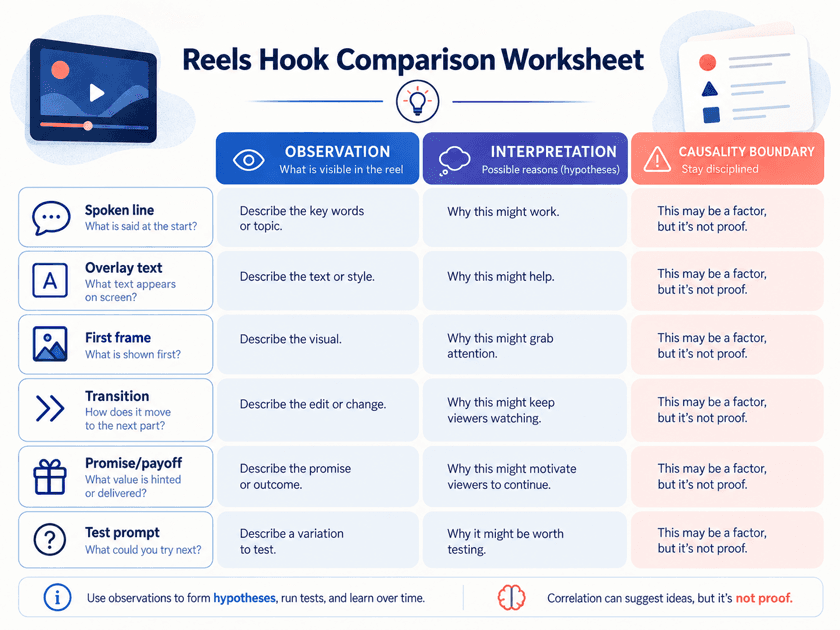
| Field | Observation: what happened? | Interpretation: what might it mean? | Causality boundary |
|---|---|---|---|
| Spoken line | Exact words and entry point | It may name a recognizable problem | The line is not proof of any outcome |
| Overlay text | Words, timing, placement, relation to speech | It may clarify or narrow context | Text alone does not establish an effect |
| First frame | Subject, action, framing, visible context | It may make the topic easier to identify | The frame does not prove why a Reel performed |
| Transition |
Compare at least two relevant openings before calling something a pattern. If two Reels state the audience problem before introducing the method, the defensible conclusion is that this order is worth studying. It is not “problem-first is the best hook.” Meta testing material, Buffer's advice, and Hootsuite's examples can inform the fields in your worksheet, but they do not combine into proof of an isolated organic hook effect.
Adapt the structure, not the creator's expression. You may keep an abstract production question such as “what if the audience problem appears before the method?” You must replace the topic, audience context, wording, footage, voice, examples, evidence, and payoff.
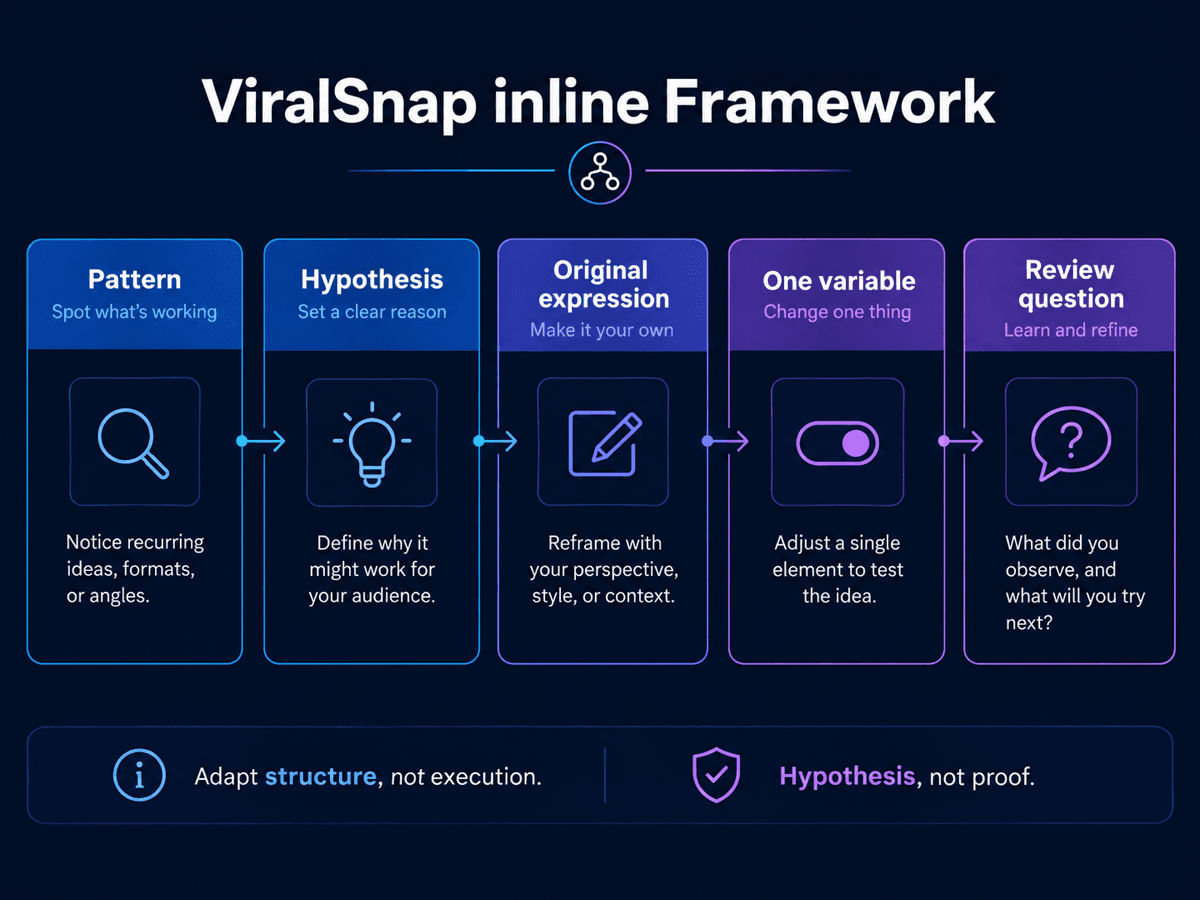
Write the experiment brief in five parts:
Meta's original-content guidance and intellectual-property guidance provide platform and rights boundaries. They are not legal advice and they do not show that a particular opening performs better. Do not reuse a creator's script, distinctive phrasing, footage, or assets without the appropriate rights.
For example, if several references identify a specific learner mistake before explaining a method, a language teacher can write a new opening about a problem from their own classroom, use their own footage and example, and make the later explanation fulfill that scope. The structural lesson has been adapted; the expression and substance are original.
These are deliberately a small set of original illustrations, not another generic hook list or a collection of creator scripts.
Spoken problem plus clarifying overlay. A solo language tutor names one recurring learner mistake. The overlay narrows it to a specific situation. Record how speech and text divide the work. For the experiment, change the overlay wording while keeping the teaching point original; do not claim the combination causes a metric change.
Mid-action entry plus result reveal. A ceramic maker begins while taking a piece from a kiln, then states the question the Reel will answer. Record the action, reveal, and explanation order. Adapt the structure with your own footage and topic; do not describe motion as a proven attention lever.
Contradiction plus truthful payoff. A meal-prep creator opens with a counterintuitive but real constraint, then demonstrates it with an original recipe. Check whether the later material honestly fulfills the opening. Treat contradiction as a study prompt, not a proven formula.
For a bounded comparison example, log two openings for the same creator and problem using identical worksheet fields. One may provide clearer context while the other enters the action sooner. Without an account-specific test, neither is declared the winner. These examples are illustrations inspired by supported patterns, not quotations or evidence of performance.
ViralSnap fits after you choose a small reference set and before you write an original experiment brief. The four approved capabilities are bounded: ViralSnap can analyze Instagram creator videos and organize observable content patterns; break down observable hooks, script structure, pacing, and CTA patterns for study; compare observable structures and patterns across selected creator videos; and use analysis observations to develop original hooks, scripts, and content experiments.
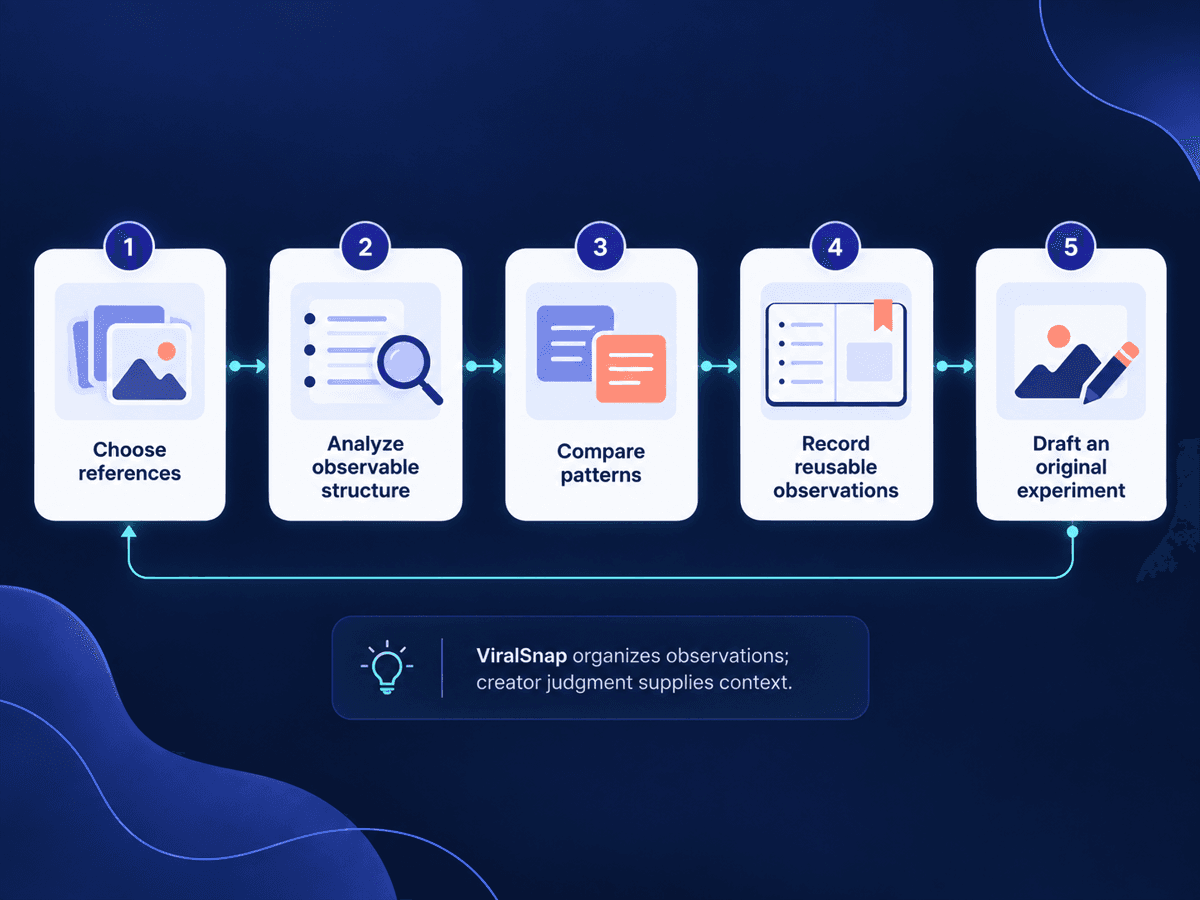
That role is deliberately practical. It helps you keep observations together, compare selected videos, and carry a structural lesson into an original brief. It does not predict the Instagram algorithm, automatically determine why a Reel performed, rank a guaranteed winner, or replace creator judgment.
For a related explanation of observable video structure, see AI video analysis. For the broader observation-to-idea workflow, see video observations and content ideas. These links extend the learning path; they are not promises about outcomes.
When you are ready to apply the workflow, Analyze reference videos with ViralSnap and turn your observations into an original experiment.
Observation is not causality. A visible opening can appear alongside a result without proving that it caused the result. The current package contains no public primary evidence isolating one organic Reels opening variable or establishing a universal opening duration.
Keep each source in its lane. Meta ad guidance belongs to creative and testing context, not isolated organic-hook proof. The Douyin study belongs to a different platform and sample; use it for measurement framing and limitations, not as Instagram evidence. Buffer and Hootsuite remain practitioner sources and examples, not controlled causal studies.
Audio, safe zones, and intellectual property are production constraints. Music availability depends on account, region, license, and use. Safe-zone placement supports readability and visibility checks. Rights questions may require permission or licensing. The article does not make legal conclusions, and it does not recommend copying scripts or assets.
The next test should be bounded: choose one audience problem, write one original opening, change one structural variable, record the context, and review the result with the analytics available to that account. Topic, audience, distribution, timing, and other factors still matter. A single experiment cannot prove why a reference Reel produced a particular response.
The most useful way to study hooks for Instagram Reels is to treat the opening as a coordinated window. Observe the spoken line, text, first frame, and transition; compare them across a small reference set; interpret cautiously; adapt the structural lesson with original substance; and test one clear choice in your own work.
The output is not a giant hook list. It is a traceable question, a useful observation, a bounded hypothesis, and an original experiment you can review on its own terms.
Analyze hooks, pacing, scenes, and storytelling patterns with AI.
| It may change how information arrives |
| A transition is not a proven attention cause |
| Promise/payoff | What the opening sets up and what follows | The explanation may be aligned with the opening | Alignment is not causal evidence |
| Test prompt | One original variable and review question | It may be worth trying for this audience | Do not write a guaranteed outcome |