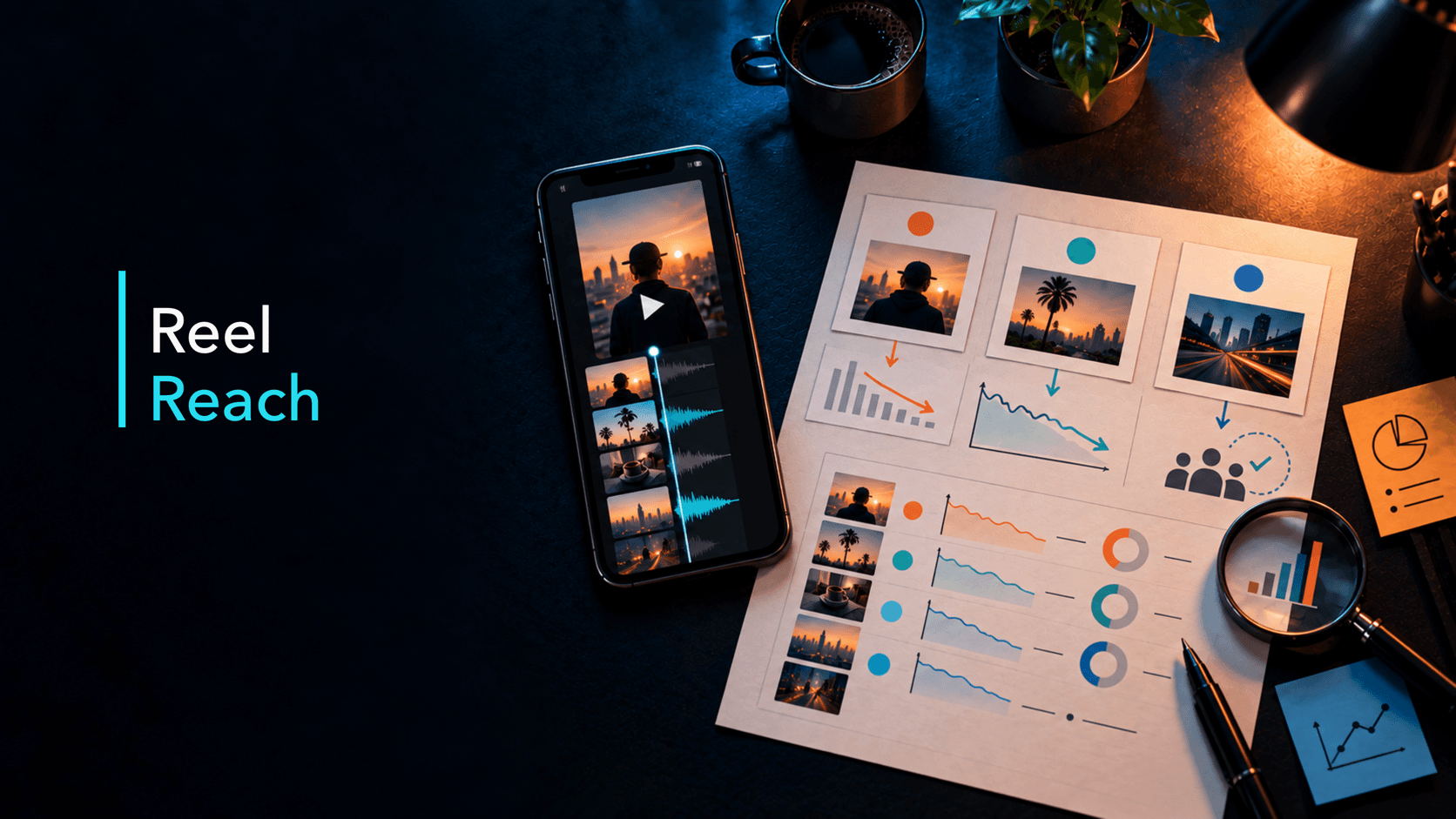
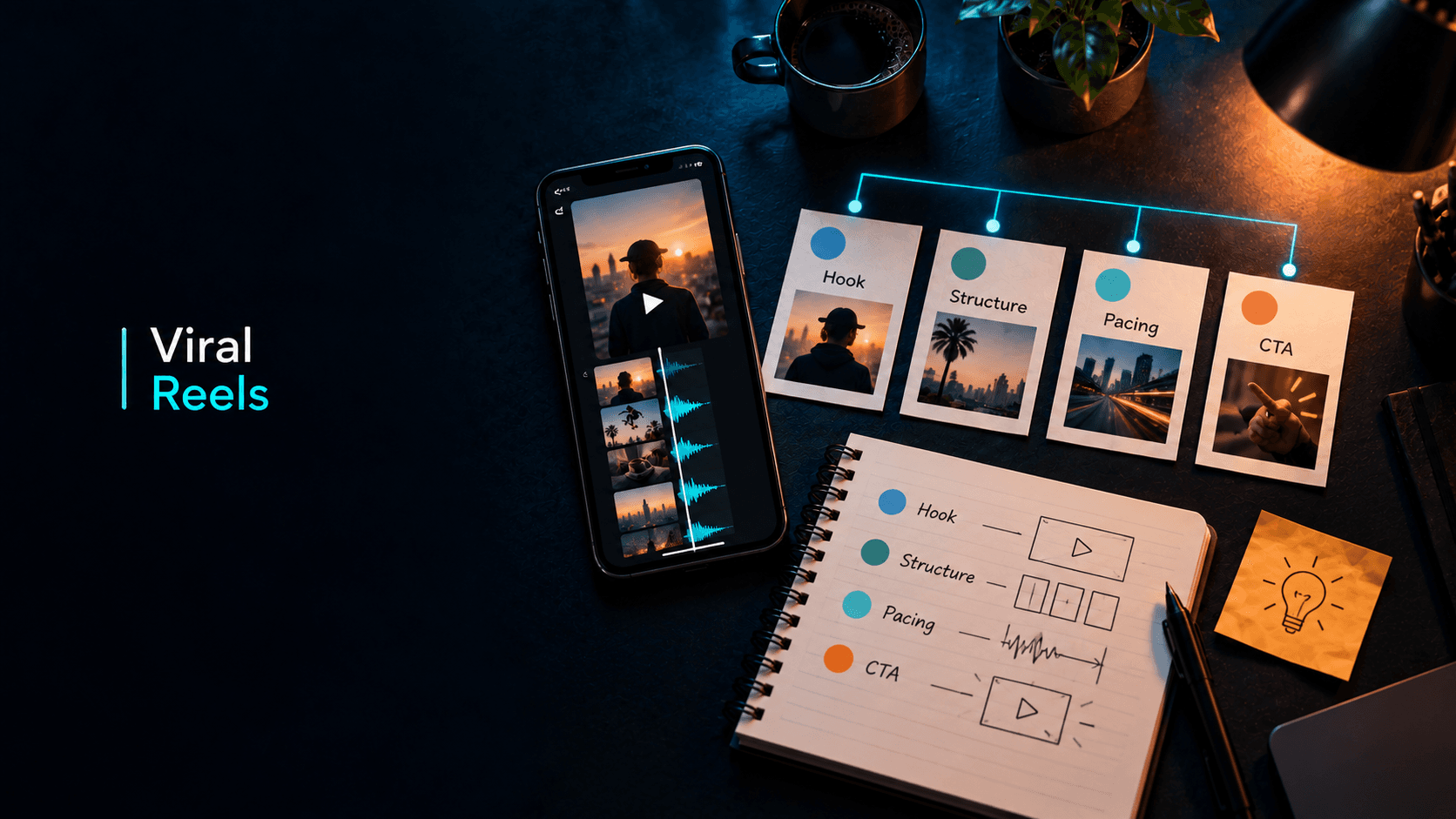
Instagram Reels trends are useful when they help you notice a change in how people create, discover, or discuss short-form video. They become less useful when they are treated as a list of guaranteed hooks, sounds, or posting formulas.
For 2026, the most practical approach is to watch a few directional signals—original production, localized storytelling, serialized formats, and creator-led discovery—then test the underlying creative choice with your own audience. A trend is a research prompt, not a promise of reach, virality, or sales.
This guide shows how to separate a platform announcement from your own observation, decide whether a trend fits your work, and turn it into an original Reel experiment.
What counts as an Instagram Reels trend?
“Trend” can describe several different things:
- A feature trend: a new creation, translation, remix, or viewing feature changes what creators can make.
- A format trend: episodic videos, recurring series, screen recordings, or a particular editing structure becomes more visible.
- A topic trend: audiences gather around a recurring subject such as beauty, fitness, fashion, comedy, or product discovery.
- A creative pattern: several Reels use a similar opening, pacing change, demonstration, or CTA structure.
These categories are easy to mix up. A new feature is not automatically a creative trend. A popular audio is not proof that the audio caused a Reel’s result. A repeated format may be a useful pattern to investigate, but it still needs audience fit and original substance.
Meta’s own 2026 announcements are a helpful starting point, but they need careful reading. For example, Meta has reported a greater prevalence of original posts in US Instagram recommendations and described new creation tools in Edits. That is platform context—not evidence that every Reel made in a particular tool will be recommended.
Four Instagram Reels trend directions worth watching in 2026
1. Original and natively produced content
Originality is becoming a more important editorial and distribution consideration across Meta’s video ecosystem. Meta says it increased the prevalence of original content in US Instagram recommendations in Q4 2025. In a separate March 2026 announcement about Facebook Feed and Reels, Meta described direct creator production and meaningful additions such as fresh information or analysis as examples of original value. It also warned that duplicative uploads and low-value edits can be deprioritized.
The useful takeaway is not “copy less because the algorithm is watching.” It is more concrete: make the new contribution obvious.
That contribution could be:
- a new explanation of a familiar problem;
- your own test, demonstration, or evidence;
- a product-specific adaptation with different footage and wording;
- a meaningful analysis that changes what the viewer can learn;
- a series with a clear point of view rather than a repost with decoration.
If you study another creator’s Reel, keep the research and the final creative separate. Do not reuse distinctive wording, footage, music, or assets simply because they appear to be part of a trend. Use the structure as a question: what communication problem is this format solving, and what is your own answer?
2. Localized and translated storytelling
Meta has continued expanding AI translation, dubbing, and lip-sync support for Reels across languages. That makes localization a trend direction worth watching for creators with audiences in more than one language or market.
Localization is more than changing subtitles. A responsible test might change the spoken language, examples, references, caption style, or opening context while keeping the core topic stable. A creator could make one original explanation for a local audience rather than publish a literal translation that sounds unnatural.
Use this direction when there is a real audience reason. Consider:
- Which audience segment is underserved by the current language or context?
- Which parts of the Reel need cultural adaptation rather than translation?
- Can the voice, product claim, and examples remain accurate after adaptation?
- How will you compare the versions without assuming the language caused every difference?
Feature availability can vary by account, country, and rollout. Translation is also not evidence of better performance on its own. It is a way to test whether the same useful idea becomes clearer or more relevant for a particular audience.
3. Serialized and deeper storytelling
Instagram’s expansion toward TV viewing includes tests around longer-form creator content, episodic series, live experiences, and horizontal video for the living room. That does not mean every mobile Reel should become long or horizontal. It does suggest that some creators may experiment with a stronger sense of continuity: recurring episodes, connected questions, and a reason to return.
A small series can be easier to evaluate than one long video. For example:
- Episode 1 names a specific customer problem.
- Episode 2 demonstrates one approach.
- Episode 3 compares two variations.
- Episode 4 reviews what the creator learned.
The series should still work at the individual-episode level. Give each Reel its own context, payoff, and clear next action. A cliffhanger without useful information may create curiosity but does not automatically create a durable audience relationship.
When testing a series, keep the topic, audience, and production standard consistent enough to compare. Track whether viewers understand the sequence, not only whether one episode received more plays than another.
4. Creator-led discovery and commerce context
Meta’s June 2026 research about India describes Reels as a major surface for discovery and reports strong interest in genres including beauty, fashion, lifestyle, fitness, comedy, and sports. The same announcement connects creator-led video with product discovery and purchase consideration in that market.
The general lesson is not that one category is universally “best.” It is that people often encounter products through a creator’s explanation, demonstration, comparison, or point of view before they are ready to act.
For product content, watch how the product earns a place in the story:
- Is it introduced as the response to a recognizable problem?
- Is the demonstration specific enough to inspect?
- Does the creator explain who the product is for?
- Is the CTA consistent with the viewer’s level of understanding?
Avoid turning “discovery” into an unsupported performance claim. The product moment may make the content more understandable; it does not guarantee clicks, conversions, or revenue.
How to tell a signal from noise
Before adapting a trend, write down its evidence level. A useful note has four layers:
| Layer | Question |
|---|
| Source | Is this a platform announcement, a tool update, a study, or an observation from a few Reels? |
| Observation | What can another viewer verify in the video or format? |
| Interpretation | What might the choice help this audience understand or feel? |
| Test | What single variable will you change in your own original Reel? |
This keeps “I saw several creators use it” separate from “this causes reach.” The first can be a valid observation. The second needs much stronger evidence and is often not knowable from public examples alone.
Also check whether the pattern repeats across different creators, topics, and audiences. A single viral-looking Reel is a weak basis for a trend claim. Five to ten references can be enough to identify a question worth testing, provided you record the source and context instead of relying on memory.
A practical trend scorecard
Score each direction from 1 to 5, or simply write a short note.
| Dimension | What to ask |
|---|
| Audience fit | Does this solve a real communication problem for the people you want to reach? |
| Original contribution | What will be genuinely new: evidence, explanation, footage, story, or point of view? |
| Repeatability | Can you make three to five useful variations without forcing the format? |
| Production cost | Can you produce it well with the time, people, tools, and rights you actually have? |
| Rights and safety | Do you have permission for the footage, music, examples, and claims involved? |
| Testability | Can you define one bounded question and a sensible review window? |
A trend with high novelty but low audience fit is usually a distraction. A direction with moderate novelty and strong repeatability may be more valuable for a small team because it creates a workable learning loop.
A seven-day trend test
Use a short cycle rather than committing your whole content calendar.
- Day 1: collect references. Save five to ten public Reels and record hook, structure, pacing, visual proof, product moment, and CTA.
- Day 2: name the pattern. Write one neutral sentence, such as “these Reels introduce a concrete problem before explaining the method.”
- Day 3: choose your contribution. Decide what will be original in your version: your audience, wording, footage, example, evidence, or product context.
- Day 4: draft two variants. Change one structural variable while keeping the topic and offer close enough to compare.
- Day 5: check rights and clarity. Confirm music, footage, claims, translations, captions, and safe-area placement.
- Days 6–7: publish and review. Compare the outcome with the question you wrote down. Use account data and qualitative feedback, not a universal “trend score.”
For metric definitions and context, see Instagram Reels Analytics. The point is not to prove that a trend caused the result. The point is to make the next creative decision more informed.
How ViralSnap can support trend research
ViralSnap can help you analyze supported public Instagram Reels and inspect observable hooks, scripts or transcripts, scenes, pacing, visuals, product moments, and CTA patterns. You can use those observations to build an original product-specific script or storyboard.
The boundary matters: ViralSnap does not predict the Instagram algorithm, identify a guaranteed winning trend, or guarantee reach, virality, engagement, conversions, or revenue. Your research should preserve the source, uncertainty, rights notes, and final editorial judgment.
For a deeper framework on separating patterns from formulas, read Viral Reels. For the step from observation to original concepts, see video observations and content ideas and Reels ideas. If you want to classify the opening move first, use the Instagram Reel Hook Taxonomy.
Analyze a supported public Reel with ViralSnap and turn one observable direction into a bounded, original experiment.
Frequently asked questions
What are the biggest Instagram Reels trends in 2026?
The most useful directions to watch are original and natively produced content, localized storytelling, serialized or deeper formats, and creator-led discovery around specific audience or product contexts. They are directions to investigate, not guaranteed performance categories.
What audio is trending on Instagram Reels?
Audio changes quickly by market, account, and week. Treat a sound as a distribution or editing input, not the strategy itself. Check licensing and commercial-use conditions, then ask whether the audio supports the story you are making.
How long does an Instagram Reels trend last?
There is no universal lifespan. A sound or visual meme may fade quickly, while a format such as a recurring series or product demonstration can remain useful longer. Judge the trend by audience fit and repeatable learning rather than by an assumed expiration date.
Can I copy a trending Reel?
Study the observable structure, but do not copy distinctive wording, footage, music, or assets without the relevant rights. Make the new contribution clear through your own topic, voice, examples, evidence, and production.
Does following a trend guarantee more views?
No. A trend can give you a timely creative question, but it cannot guarantee reach, views, retention, engagement, conversions, or revenue. Test one variable and review the evidence in your own account context.